Many staffing agencies start with multiple tools: an ATS for candidates, a CRM for relationships, and billing software for invoices.
At first, this setup works. But as the agency grows, these tools turn into silos. Candidate data gets duplicated, recruiters waste time switching platforms, client relationships get missed, and finance teams manually pull placement details before creating invoices.
That’s why more staffing agencies are abandoning the ATS, CRM, and billing triad in favor of something better: recruitment automation software that unifies all elements of staffing agency management.
Instead of separate views of candidate relationships and billing, why not unify everything under one roof?
Everything from managing candidates to candidate relationship management to staffing agency billing software can fall under a unified recruitment operations system.
Why Staffing Agencies Outgrow Separate Recruitment Tools
Staffing agencies are very different from internal HR departments.
Where a corporate HR department looks after the recruitment process for one company, staffing agencies handle multiple clients and deal with hundreds of candidates.
Recruiting management software needs to reflect this reality.
As a staffing agency grows, the problems of separate recruitment tools become more acute.
Duplicate Candidate Data
When ATS and CRM tools are separate, duplicate candidate data becomes a huge issue.
Recruiters waste time trying to find the right candidate profile in ATS when they have to look elsewhere for communication history or where the candidate was actually placed.
This is why candidate relationship management is increasingly becoming an important part of staffing operations.
With CRM in the mix, teams can finally see the full picture of where a candidate came from and where they might be headed.
Incomplete Visibility of Candidates
Candidates come and go, but not every candidate who walks through the staffing agency door is headed for an immediate placement.
Sometimes hiring managers are simply browsing or casting a wide net.
Sometimes the ideal candidate for one department is rejected by another.
That’s why candidate relationship management comes into play: agencies must know where they stand with candidates before, during, and after the hiring process.
Recruitment CRM software helps with that.
Invoice Creation Depends on Recruitment Information
For staffing agencies, recruiting doesn’t end when a hire is made.
Bill rates come into play, as do:
- Pay rates
- Invoices
- Timesheets
- Revenue tracking
This is why staffing agencies are looking for billing solutions integrated directly with recruitment operations.
This removes the possibility of manual entry errors when finance pulls information from the placements team.
What an ATS Does for Staffing Agencies
ATS software sits at the center of recruitment operations.
It captures:
- Job orders
- Resume applications
- Interview schedules
- Candidate tracking
Any good Application tracking system software should allow recruiters to answer:
- Where is this candidate in the application process?
- Which positions have they applied for?
- What is the status of this particular application?
An ATS gives structure to staffing agency recruitment operations.
However, an ATS does not cover the agency’s long-term candidate and client relationships.
That’s where candidate relationship management comes into play.
What CRM Does for Staffing Agencies That ATS Can’t
While an ideal staffing agency ATS manages active applicants, candidate relationship management helps the staffing agency handle everything before and after the hiring event.
A staffing agency CRM allows the agency to store candidate data and manage those candidates while also managing job orders and clients.
Staffing agency recruiters need to know where a candidate fits, but that opportunity may come later.
That’s why staffing agency CRM software becomes important.
Using recruiting CRM software, recruiters can manage candidate data long after the original hiring process.
Six months down the line, that rejected job order may have the perfect opening for a candidate the agency placed before.
Without the right CRM, that opportunity is wasted.
This is why staffing agencies use candidate relationship management to keep long-term connections alive.
Why Billing Needs to Be Connected With Recruitment
The finance team touches every part of a staffing agency’s process.
From candidate sourcing and placement to timesheets and invoices, finance is the backbone of staffing operations.
This is why staffing agencies are adopting staffing agency billing software to unify financial operations with recruitment operations.
Disconnected billing software makes operations unnecessarily complex:
Candidate is placed → recruiter marks candidate details in a spreadsheet → finance reviews spreadsheet → invoice is created.
By integrating finance processes with staffing operations, revenue can be better tracked, predicted, and analyzed.
The Problems With Separate ATS, CRM, and Billing Tools
Disconnected recruitment tools have serious downsides.
Here’s why staffing agencies are moving away from separate CRM, ATS, and billing software.
Data Lives in Separate Apps
When ATS, CRM, and billing software are not unified, recruiters, finance teams, and staff may work with outdated information.
Recruitment data can become disconnected when it is not part of a larger staffing agency software suite.
Human Copy-Paste Between Tools Creates Errors
When billing software is separate from ATS, finance teams often need to manually transfer billing details from placed candidates into billing systems.
This creates unnecessary work and increases the possibility of errors.
Recruiters may also need to update candidate data in multiple places, leading to confusion and missed updates.
When agencies manage high-value candidate and client relationships, these extra steps become inefficient.
This is a major reason why staffing agencies are turning to automation.
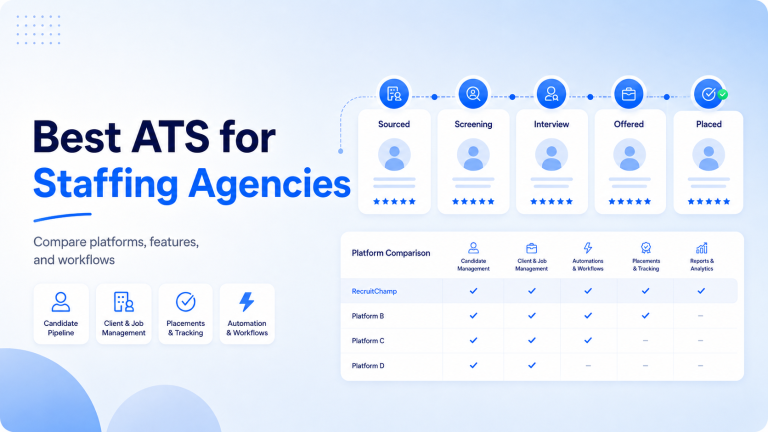
What to Look for in an All-in-One Recruitment Platform
Recruitment agencies are moving toward unified staffing agency software to manage:
- Applications
- Relationship management
- Financial tracking
When evaluating recruiting management software options, staffing agencies should consider the following capabilities.
Look for ATS Features
A recruitment management software solution should include essential ATS capabilities.
These include:
- Candidate pipelines
- Job management
- Resume parsing
- Interview management
Consider CRM Abilities
Not all staffing agency recruitment software includes strong CRM capabilities.
Make sure your staffing agency software includes features for managing:
- Candidate relationships
- Client relationships
- Long-term engagement
Billing Capabilities
Some candidates have unique billing needs based on their roles or industries.
A good billing system should support:
- Invoicing
- Timesheets
- Rate calculations
- Payment workflows
Recruitment Automation Software
Recruitment automation software makes a major difference in staffing agency productivity.
Look for features that streamline:
- Auto follow-ups
- Email communication
- Meeting scheduling
- Process automation
Reporting and Analytics Tools
The right staffing agency software should provide recruitment analytics reports.
These reports help agencies understand:
- Revenue performance
- Recruiter performance
- Operational strengths and weaknesses
How recruitChamp Helps Staffing Agencies Unify Their Recruitment Operations
recruitChamp offers staffing agency software designed to help agencies manage:
- Candidates
- Clients
- Recruitment operations
Recruiter management and automation features help staffing agencies manage everything from applicant tracking to candidate CRM to billing management.
This is especially valuable for staffing agencies where candidate management becomes increasingly complex.
recruitChamp takes a modular approach to staffing agency software:
- ATS
- CRM
- Billing
all come together into a larger recruitment management software solution.
Recruiting management software provides a unified view of:
- Candidate tracking
- Candidate relationship management
- Billing
all in one place.
Whether you’re managing ATS, CRM, or staffing agency billing software, recruitChamp provides tools to improve productivity and maintain long-term candidate and client relationships.
FAQs
Staffing agencies manage candidates, clients, and revenue simultaneously.
By unifying ATS, CRM, and billing into one system, staffing agencies can reduce duplicate data, improve visibility, and generate better reports.
An ATS manages the active recruitment process, while a CRM manages long-term client and candidate relationship management.
ATS handles:
• Candidates
• Interview scheduling
• Job requisitions
CRM manages:
• Candidate relationships
• Client relationships
• Long-term engagement
Billing integration connects candidate placements, timesheets, rate cards, and invoices.
This reduces manual input and improves revenue consistency.
Recruitment automation software helps staffing agencies simplify and streamline recruitment operations.
Features such as:
• Auto follow-ups
• Email automation
• Meeting scheduling
• Process automation
help agencies improve productivity.
The best recruitment software for agencies should cover:
• Candidates
• Clients
• Revenue
A strong platform combines:
• ATS
• CRM
• Billing
• Automation
to help staffing agencies become more productive.