Summarize with AI
There’s a question that keeps surfacing in boardrooms and leadership off sites across industries: why are our people leaving, and what can we do about it?
The answers are rarely simple. Employees don’t disengage overnight. It happens gradually, through small frustrations that accumulate over time. A clunky onboarding process. A manager who has no visibility into their team’s development needs. A payroll error that takes two weeks to resolve. A performance review that feels disconnected from anything that happened during the year. Individually, these feel like operational hiccups. Collectively, they signal something more serious: an organization that hasn’t invested in making the employee experience as thoughtful as the customer experience.
This is the gap that modern HR Management Software is closing, and it’s doing so in ways that go far beyond digitizing paperwork.
From Admin Tool to Strategic Infrastructure
For a long time, HR software had a reputation problem. It was seen as back-office technology: necessary, perhaps, but not particularly strategic. Payroll had to run. Attendance had to be tracked. Compliance boxes had to be ticked. HR systems were the plumbing of the organization, vital but invisible.
That perception has fundamentally shifted. Today, HR Management Software sits at the center of how organizations plan, develop, and retain their workforce. It connects hiring to onboarding, onboarding to performance, performance to learning, and learning to career progression. When those connections work well, employees feel seen, supported, and valued. When they don’t, the gaps show up in engagement scores and exit interviews.
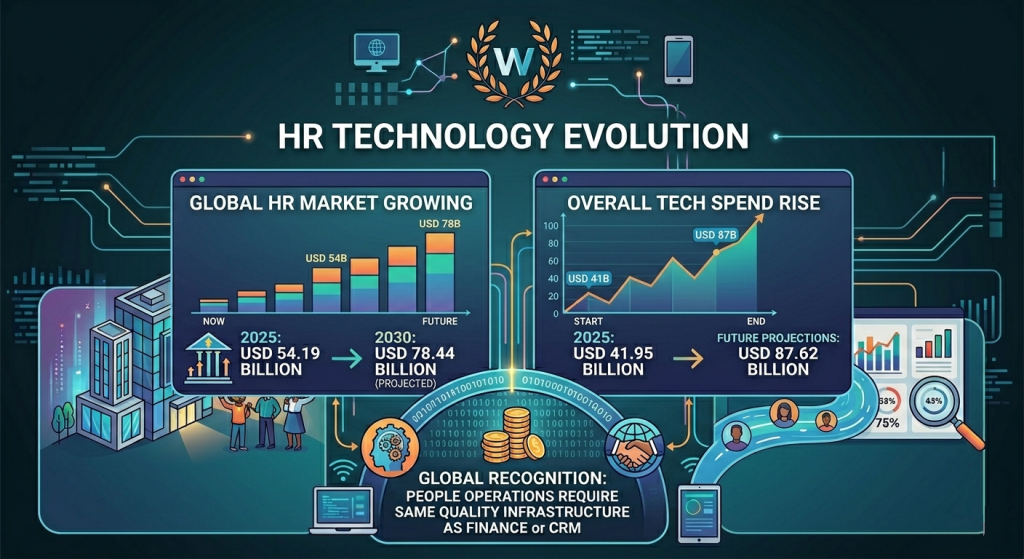
The market reflects this evolution. The global HR software market reached approximately USD 54.19 billion in 2025 and is projected to grow to USD 78.44 billion by 2030, at a compound annual growth rate of 7.4%. Overall HR technology spend is estimated at USD 41.95 billion in 2025, with projections pointing toward USD 87.62 billion in the years ahead as organizations digitize every stage of the employee lifecycle. These aren’t the numbers of a niche category. They represent a global recognition that people operations require the same quality of technology infrastructure as finance or customer relationship management.
Getting the Fundamentals Right
Before any business can focus on engagement, it has to get the basics right. And the basics in HR are more complex than they appear.
Accurate payroll. Up-to-date employee records. Transparent benefits administration. Reliable attendance tracking. Policy compliance across locations. These aren’t glamorous capabilities, but when they fail, the damage to employee trust is swift and lasting. Nothing erodes confidence in an employer faster than a payroll error or a benefits confusion that takes weeks to resolve.
Core HR capabilities, covering systems of record for employees, payroll, benefits, attendance, and compliance, account for approximately 36% of the global HR Management Software market in 2025. That means more than a third of all HR software investment is focused on these foundations. And rightly so, because the ability to deliver strategic, engagement-focused HR depends entirely on having clean, reliable data underneath it.
When HR teams are no longer spending their days manually reconciling spreadsheets, chasing down attendance records, or correcting payroll discrepancies, they gain something invaluable: time. Time to think about workforce planning. Time to have meaningful conversations with managers about team dynamics. Time to design development programs that actually reflect what employees need. HR Management Software, at its best, is what makes that shift possible.
The Engagement Crisis Is Real
Let’s be direct about the challenge businesses are facing. Employee disengagement is not a soft concern. It has measurable, material consequences.
Disengaged employees are less productive, more likely to make mistakes, and significantly more likely to leave. The cost of replacing an employee typically ranges from 50% to 200% of their annual salary, depending on the role and level of seniority. Across a workforce of hundreds or thousands, that adds up to a staggering amount of avoidable expenditure.
The causes of disengagement are well documented. Employees want to feel that their work has purpose, that their manager is invested in their growth, that the organization communicates transparently, and that their contributions are recognized. These needs aren’t unreasonable. But they are difficult to meet consistently at scale without the right systems in place.
This is precisely where HR Management Software makes a structural difference. It doesn’t just help HR teams work more efficiently. It creates the conditions in which managers can lead more effectively, employees can advocate for their own development, and leadership can make decisions grounded in real workforce data rather than assumptions.
Onboarding: Where Engagement Begins
Engagement doesn’t start on day 90. It starts on day one, arguably even before that.
Research consistently shows that employees who experience a structured, meaningful onboarding process are significantly more likely to stay with a company beyond their first year, and significantly more likely to report high levels of engagement in the early months of their tenure. Yet many companies still treat onboarding as a checklist: forms to sign, systems to access, a tour of the office. It ticks the compliance boxes but misses the human opportunity.
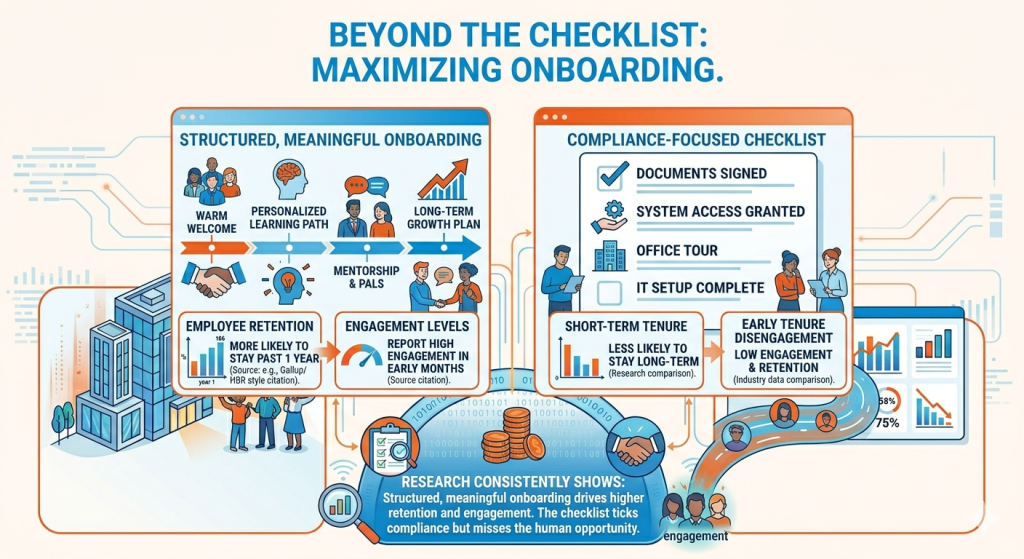
Modern HR Management Software transforms onboarding into a genuine welcome experience. Automated workflows ensure that nothing falls through the cracks, from IT provisioning to manager introductions to initial goal-setting. New joiners can complete documentation, access resources, and connect with colleagues through a single, intuitive platform before they’ve even walked in the door. Managers receive prompts to check in at key moments. The whole process feels coordinated and intentional rather than improvised.
That first impression matters enormously. An employee who feels supported and prepared in their first weeks is far more likely to become invested in the firm’s success.
Performance Management That Actually Drives Growth
Traditional performance reviews have a well-earned reputation for being stressful, infrequent, and largely disconnected from day-to-day reality. An annual conversation about what happened twelve months ago is not a development tool. It is, at best, a formality.
HR Management Software enables a fundamentally different approach. Continuous feedback tools allow managers and employees to capture conversations, celebrate progress, and flag challenges in real time. Goal-setting frameworks connect individual objectives to team and organizational priorities, so employees can see how their work contributes to something larger. Development plans are built into the workflow, not bolted on at appraisal time.
The impact on engagement is significant. When employees receive regular, meaningful feedback, they feel more confident, more motivated, and more connected to their role. When development conversations happen throughout the year rather than once at the end of it, employees see genuine investment in their growth. And when that investment is visible and consistent, retention follows.
Data-Driven People Decisions
One of the most transformative capabilities that HR Management Software brings to the engagement conversation is analytics.
Historically, HR operated largely on instinct and lagging indicators. An organization would notice that turnover had increased, or that engagement scores had dipped, but by the time those signals were visible, the underlying issues had often been building for months. Addressing them reactively was expensive and slow.
Modern platforms change this by surfacing real-time data on workforce trends: absenteeism patterns, performance trajectories, learning completion rates, internal mobility, compensation benchmarks, and much more. HR leaders and people managers can identify at-risk employees before they’ve decided to leave, spot teams that are showing signs of burnout, and intervene with targeted support rather than broad programs that may or may not address the actual issue.
This shift from reactive to proactive people management is one of the most meaningful ways HR Management Software is reshaping the engagement landscape. It gives organizations the intelligence to act with precision, and to demonstrate to employees that they are paying attention.
The Cloud Advantage: Reaching Every Employee, Everywhere
The rise of remote and hybrid work has added a layer of complexity to employee engagement that no amount of town halls or ping-pong tables can fully address. When employees are distributed across cities, time zones, and working patterns, the challenge of creating a consistent, connected experience becomes significant.
Cloud-based HR Management Software is built for this reality. Cloud solutions now hold approximately 74% of the global HR management market in 2025, driven by the need for scalability, remote access, and seamless integration with other business systems. A cloud-native platform means that every employee, regardless of location, accesses the same tools, sees the same information, and receives the same quality of HR support. Policies are consistent. Communications are centralized. Development opportunities are visible to all.
This consistency matters for engagement. Employees who feel that they are treated equitably, that geography or working pattern doesn’t determine the quality of their experience, are more likely to feel a genuine sense of belonging. And belonging, as the research shows, is one of the strongest predictors of long-term retention.
Why Integrated Platforms Outperform Point Solutions
There is a temptation, particularly in fast-growing organizations, to solve HR challenges one at a time. A learning platform here. An engagement survey tool there. A separate system for performance management. It feels agile, but it creates exactly the kind of fragmentation that undermines the employee experience.
When an employee’s learning history lives in one system, their performance data in another, and their payroll information somewhere else entirely, the organization loses the ability to see the whole person. Managers can’t connect the dots. HR leaders can’t draw meaningful insights. And employees, who often sense when the organization doesn’t have a coherent picture of them, become less invested.
The HR Management Software market is increasingly reflecting this reality. Cloud-based, all-in-one platforms are winning over point solutions, because they bring employee data, payroll, time, benefits, compliance, learning, and performance into a single system of record. The overall market is projected to reach approximately USD 56.23 billion by 2034, growing at an 11.8% compound annual growth rate, notably faster than many traditional enterprise software categories. Organizations that continue to rely on fragmented tools risk slower decision-making, higher compliance exposure, and an employee experience that falls short of what the best candidates and current employees now expect.
recruitChamp: Where HR and Recruitment Converge
For staffing and recruitment agencies, the engagement challenge has a particular dimension. The “employees” whose experience matters most aren’t just internal staff. They are the recruiters, account managers, and back-office teams whose productivity, motivation, and retention directly determine the agency’s ability to serve clients and win business.
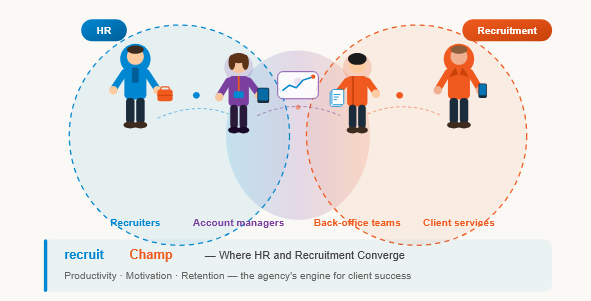
This is where recruitChamp brings a genuinely differentiated perspective. Built natively on Salesforce and designed specifically for staffing and recruitment firms, recruitChamp understands that engagement in this context means giving recruiters the tools to do their best work, without the friction of juggling multiple disconnected systems.
For multi-recruiter teams managing high-volume, multi-role hiring across permanent, contract, and MSP programs, recruitChamp consolidates ATS, CRM, vendor management, timesheets, and invoicing into a single Salesforce-native platform. The result is a working environment where recruiters can focus on candidates and clients rather than administrative overhead, where managers have real-time visibility into team performance and pipeline health, and where leadership can make strategic decisions backed by reliable data.
For firms already on Salesforce, or those ready to standardize on it, recruitChamp removes the tool-hopping and data fragmentation that drain recruiter energy and motivation. And for those who want to experience the difference before committing, a 14-day pilot offers a low-risk, fast-to-value entry point with the flexibility to adapt to each firm’s specific workflow.
The Bottom Line on Engagement
Employee engagement is not a program. It is not a survey. It is not a benefit or a perk. It is the outcome of dozens of daily interactions between employees, their managers, and the systems and processes that shape their working experience.
HR Management Software, when implemented thoughtfully, improves the quality of those interactions at every level. It gives employees visibility into their own development. It gives managers the data and tools to lead with intention. It gives HR teams the time and insight to be genuinely strategic. And it gives leadership the confidence that people decisions are being made on the basis of evidence rather than guesswork.
In a talent market where the best people have options, and where the cost of losing them is high, then that level of investment in the employee experience is not a luxury. It is, in fact, the price of staying competitive.
Frequently Asked Questions
1. What is HR Management Software?
It is a digital platform that centralizes and automates core functions like payroll, attendance, and compliance, while supporting the full employee lifecycle from recruitment to development.
2. How does it improve employee engagement?
By automating admin tasks, it frees up managers to focus on people. Integrated feedback and onboarding tools help teams feel supported and prevent early disengagement.
3. Is cloud-based software better than on-premise?
Yes. Cloud solutions are more scalable, reduce IT costs, and better support hybrid work. They now represent roughly 74% of the global market.
4. Can SMEs benefit from this software?
Absolutely. It removes the heavy administrative burden from lean teams, allowing small organizations to operate with the same consistency and rigor as large enterprises.
5. How does it support employee retention?
It enables structured onboarding and clear growth paths. Data-driven insights allow for early interventions, ensuring employees feel valued before they consider leaving.