Summarize with AI
Choosing the best ATS for staffing agencies is not about finding the software with the longest feature list.
Staffing agencies have different requirements from internal corporate recruitment teams. Recruiters may be managing multiple clients, job orders, candidate pipelines, submissions, contractors, placements, timesheets and billing at the same time.
That means the right staffing ATS needs to do more than store resumes and move candidates through hiring stages.
A strong platform should help agencies:
- Manage multiple clients and job orders
- Search and rediscover candidates
- Track candidate submissions and placements
- Connect recruiters with client activity
- Automate repetitive recruitment tasks
- Support permanent and contract staffing
- Provide reporting and operational visibility
- Connect staffing operations with billing where required
But there is no single ATS that is best for every staffing agency.
An executive search firm may prioritise CRM and candidate intelligence. A contract staffing business may care more about timesheets and billing. A growing agency may value usability and straightforward implementation.
This guide compares 10 ATS and recruitment platforms used by staffing and recruitment agencies and explains which type of agency each may fit best.
Quick Comparison: Best ATS Platforms for Staffing Agencies
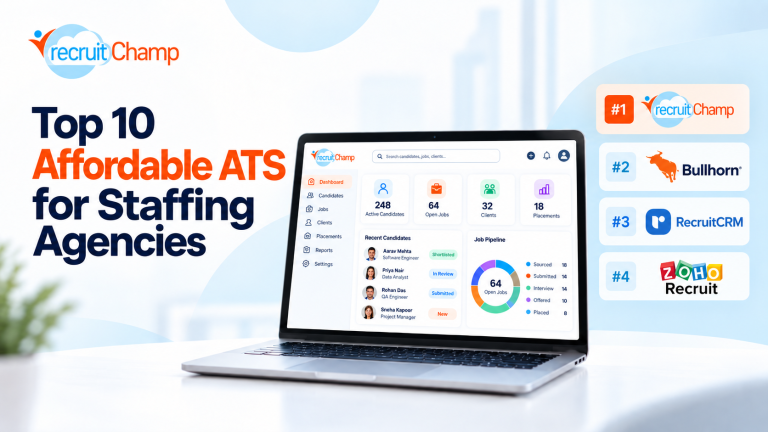
| ATS Platform | Best Fit | Key Strength | Public Pricing |
| recruitChamp | Agencies wanting connected recruitment and staffing operations | Salesforce-native ATS + CRM + TalentIQ + RecruitBilling | Plans from $15/user/month, subject to current commercial terms |
| Bullhorn | Growing and enterprise staffing businesses | Mature staffing ecosystem with ATS, CRM, AI and automation | Starter $99/user/month; Core $165/user/month; higher tiers custom |
| Ceipal | Contract, MSP/VMS and workforce-heavy staffing firms | ATS + workforce + VMS ecosystem | Request quote |
| Vincere | Growing recruitment agencies | ATS + CRM and recruitment operations | Request current pricing |
| Recruiterflow | Search and recruitment firms focused on automation | ATS + CRM + multichannel automation + AI | Platform Plan $149/user/month; AIRA custom |
| Loxo | Executive search and sourcing-focused teams | AI sourcing and talent intelligence | Check current plan pricing |
| JobAdder | Boutique to established recruitment agencies | Recruitment workflows, temp/contract support and integrations | Tailored pricing |
| Tracker | Agencies needing ATS + CRM with contractor operations | ATS/CRM, AI matching, timesheets and workforce features | From $79/user/month |
| Recruit CRM | Small and growing recruitment agencies | ATS + CRM + AI sourcing and automation | Pro $95, Business $135, Enterprise $215/user/month |
| Zoho Recruit | Budget-conscious or Zoho-based teams | Accessible ATS within the Zoho ecosystem | Published plans vary by region |
Bullhorn currently publishes $99/user/month for Starter and $165/user/month for Core, while Pro and Max require a quote. Recruiterflow currently lists its Platform Plan at $149/user/month and AIRA on custom pricing. Tracker starts at $79/user/month and Recruit CRM currently lists plans at $95, $135 and $215 per user/month.
Pricing changes frequently and may vary by billing cycle, region, team size, implementation, usage and add-ons. Always confirm current pricing directly with the vendor before making a purchasing decision.
How We Evaluated the Best ATS for Staffing Agencies
Not every applicant tracking system is built around agency recruitment.
For this comparison, the most important question is:
How well does the platform support the operating model of a staffing or recruitment agency?
We considered the following areas.
Candidate Management
A staffing ATS should give recruiters a structured way to manage candidate information across multiple roles and clients.
Important capabilities include:
- Candidate database
- Resume parsing
- Candidate search
- Pipeline management
- Candidate history
- Communication activity
- Previous submissions and placements
- Talent rediscovery
A strong candidate database should become more valuable over time instead of becoming an archive of old resumes.
Client and Recruitment CRM
Staffing agencies manage both sides of the recruitment relationship:
Candidates + Clients
That makes recruitment CRM capabilities particularly important.
Useful functionality may include:
- Client accounts
- Contacts
- Job requirements
- Business development pipelines
- Account activity
- Client communication
- Candidate submissions
Without connected CRM functionality, agencies may end up maintaining client and candidate information in separate systems.
AI Search and Candidate Matching
Candidate databases can contain thousands of records.
Modern recruitment platforms increasingly use AI to help recruiters:
- Search beyond exact keywords
- Identify related skills
- Rediscover previous candidates
- Rank candidate-job relevance
- Prioritise profiles for recruiter review
AI should support recruiter judgement rather than replace it.
The important question is whether the platform can make your existing candidate data easier to use.
Permanent and Contract Staffing
An agency handling permanent placements may require:
Client → Job → Candidate → Submission → Interview → Placement
Contract staffing can extend the workflow:
Placement → Contractor → Timesheet → Approval → Billing → Invoice
Agencies managing both models should evaluate how much of this workflow the ATS can support without depending on multiple disconnected tools.
Timesheets and Billing
For contract staffing businesses, the recruitment process does not end when a candidate is placed.
Platforms may also need to support or connect with:
- Timesheets
- Rate structures
- Approvals
- Contractor records
- Billing
- Invoicing
These capabilities are not necessary for every agency, but they become important when contractors form a significant part of the business.
Vendor Management
Agencies working with MSPs, VMS programmes or external suppliers may need functionality around:
- Vendors
- Job distribution
- Candidate submissions
- Contractor records
- Compliance information
- Reporting
A platform built mainly for permanent recruitment may require additional systems for these workflows.
Reporting and Automation
Recruitment leaders should be able to understand:
- Open jobs
- Candidate pipelines
- Recruiter activity
- Submissions
- Interviews
- Placements
- Client activity
More operationally focused staffing platforms may also provide visibility into contractor, timesheet and billing activity.
1. recruitChamp
recruitChamp is a Salesforce-native recruitment platform designed to connect applicant tracking with wider staffing agency operations.
Rather than treating ATS, client management and billing as completely separate processes, recruitChamp brings together areas such as:
- Applicant Tracking System
- Recruitment CRM
- Candidate Finder
- TalentIQ
- Resume parsing
- Candidate communication
- Interview and job scheduling
- Vendor management
- Contract staffing workflows
- Timesheets
- RecruitBilling
- Reports and dashboards
Who Is recruitChamp Best For?
recruitChamp is particularly relevant for agencies that want one connected platform across recruitment and staffing operations.
This may include:
- Permanent staffing firms
- Contract staffing agencies
- Professional recruitment firms
- Technical staffing businesses
- Multi-client recruitment agencies
- Teams already using or interested in Salesforce-based workflows
Where recruitChamp Stands Out
Salesforce-Native Architecture
recruitChamp is built on Salesforce.
That means candidate, client, job and related recruitment information can operate within the same underlying environment rather than relying entirely on data synchronisation between an external ATS and Salesforce.
ATS + Recruitment CRM
Recruiters can manage candidate workflows while account and business-development activity remains connected with client information.
The process can follow:
Client → Requirement → Job → Candidate → Submission → Placement
This is particularly useful for agencies where recruitment delivery and account management need to work together.
TalentIQ and AI Candidate Matching
recruitChamp goes beyond traditional keyword-based database search through TalentIQ.
AI candidate matching can help recruiters:
- Find relevant candidates
- Prioritise profiles
- Rediscover existing talent
- Reduce manual candidate searching
- Understand why candidates may match a requirement
This can be particularly valuable for agencies with large historical candidate databases.
Contract Staffing and RecruitBilling
For contract staffing, recruitChamp can continue the workflow beyond placement into operational processes such as timesheets and billing.
The broader workflow can become:
Client → Job → Candidate → Placement → Timesheet → Billing → Invoice
Explore RecruitBilling for the billing side of the platform.
Vendor Management
Vendor management capabilities can support agencies that work with external suppliers and more complex staffing structures.
Considerations
recruitChamp is broader than a simple applicant tracking system.
A very small recruitment team that only needs basic candidate tracking may not need every capability available across the platform.
Agencies should evaluate the workflow and configuration they actually require.
Best Fit
Staffing and recruitment agencies that want ATS, CRM, AI candidate matching and staffing operations within one Salesforce-native platform.
2. Bullhorn
Bullhorn is one of the longest-established platforms built specifically for staffing and recruitment businesses.
Its current offering extends beyond ATS and CRM into AI, automation, analytics and broader staffing technology.
Bullhorn currently offers Starter, Core, Pro and Max packages for smaller agencies. Starter includes applicant tracking, resume parsing and client management, while higher tiers introduce recruitment CRM, AI search and match, process automation, real-time analytics and agentic workflows.
Best Fit
Bullhorn is well suited to:
- Growing staffing firms
- Established recruitment agencies
- Enterprise staffing businesses
- Agencies requiring a broad integration ecosystem
Strengths
- Mature ATS and staffing CRM
- Extensive partner ecosystem
- Custom workflows
- AI search and matching on higher tiers
- Automation capabilities
- Strong enterprise footprint
Considerations
The platform can become more sophisticated as additional capabilities and modules are added.
Smaller agencies should compare the functionality they actually need with the cost and configuration requirements of the selected Bullhorn tier.
Best Fit Summary
Agencies wanting a mature staffing ecosystem with room to expand into more advanced automation and AI.
3. Ceipal
Ceipal is built around staffing and workforce-management use cases.
Its ecosystem includes capabilities across ATS, workforce management and VMS, making it particularly relevant for businesses handling contractors and enterprise staffing programmes.
Best Fit
Ceipal may be a good fit for:
- IT staffing agencies
- Contract staffing firms
- Healthcare staffing organisations
- MSP/VMS-focused businesses
- Agencies managing large contractor populations
Strengths
Staffing-Focused Workflows
Ceipal is designed for agency and workforce operations rather than only corporate applicant tracking.
Workforce Management
Its broader ecosystem can support operational processes that continue after placement.
VMS Capabilities
This can be valuable for staffing organisations serving enterprise customers through structured vendor programmes.
Considerations
Agencies focused mainly on permanent recruitment should determine whether they need the wider workforce and VMS functionality.
Best Fit Summary
Contract, MSP/VMS and workforce-heavy staffing organisations.
4. Vincere
Vincere combines applicant tracking and CRM functionality for recruitment businesses.
It is positioned primarily around recruitment agencies rather than internal corporate HR teams.
Best Fit
Vincere may suit:
- Growing recruitment agencies
- Specialist recruiters
- Professional staffing firms
- Agencies wanting ATS and CRM together
Strengths
- ATS + CRM
- Recruitment workflow management
- Candidate pipelines
- Business development workflows
- Analytics and operational visibility
Considerations
Agencies with highly specialised contractor, payroll or billing requirements should evaluate how those workflows are supported within their required configuration.
Best Fit Summary
Growing agencies wanting an integrated recruitment and CRM environment.
5. Recruiterflow
Recruiterflow positions itself as an end-to-end recruitment platform for search firms, combining ATS, CRM, multichannel sequences, recruitment automation and sales automation.
Its current Platform Plan is listed at $149 per user/month, while its AIRA tier uses custom pricing and adds AI capabilities such as Matchmaker and other agents.
Best Fit
Recruiterflow may suit:
- Recruitment agencies
- Search firms
- Professional recruitment teams
- Businesses prioritising outreach and automation
Strengths
- ATS and CRM
- Multichannel sequences
- Recruitment automation
- Sales automation
- Reporting
- AI functionality through AIRA
Considerations
Agencies with extensive contractor workforce, payroll or back-office requirements should evaluate whether they need additional systems beyond Recruiterflow.
Best Fit Summary
Recruitment firms prioritising automation, outreach and recruiter productivity.
6. Loxo
Loxo has built a strong position around AI-powered sourcing and talent intelligence.
It is especially relevant to recruiters that spend significant time identifying and engaging passive talent.
Best Fit
Loxo may suit:
- Executive search firms
- Specialist recruitment agencies
- Proactive sourcing teams
- Recruiters focused heavily on passive candidates
Strengths
- AI-driven candidate discovery
- Talent intelligence
- Candidate sourcing
- Outreach
- Recruitment automation
Considerations
An agency whose primary requirement is contractor administration, timesheets or complex staffing back-office workflows should evaluate those areas separately.
Best Fit Summary
Executive search and sourcing-led recruitment teams where candidate discovery is a major priority.
7. JobAdder
JobAdder provides recruitment software for both agency recruiters and internal hiring teams.
For agencies, it currently offers Lite, Essential and Pro plans, with tailored pricing rather than fixed public prices. Its agency plans include candidate and client management, job posting, temp/contract functionality, automation and reporting, with more advanced capabilities available at higher tiers.
Best Fit
JobAdder may suit:
- Boutique recruitment agencies
- Growing agencies
- Permanent recruitment teams
- Agencies combining permanent and contract recruitment
Strengths
- Candidate management
- Client management
- Job posting and distribution
- Temp and contract management
- Automation
- Reporting
- Broad integration ecosystem
JobAdder states that it integrates with more than 200 applications.
Considerations
Agencies should compare the Lite, Essential and Pro tiers carefully because functionality such as advanced automation, analytics and some integrations varies by plan.
Best Fit Summary
Agencies looking for a mature recruitment platform with flexible agency plans and integrations.
8. Tracker
Tracker combines ATS and CRM with AI search, automation and broader staffing functionality.
Its current Launch plan starts at $79/user/month and Core at $99/user/month. Professional and Enterprise are custom-priced.
Best Fit
Tracker may suit:
- Staffing agencies
- Contract staffing firms
- Recruitment businesses with growing operational needs
- Agencies requiring contractor and timesheet functionality
Strengths
Tracker currently includes ATS + CRM across all tiers and offers candidate search/match powered by an AI ranking engine. Higher tiers add functionality such as workflow automation, timesheets, candidate compliance, payroll integrations and broader workforce-management capabilities.
Considerations
Some contractor, compliance and back-office capabilities are available only on higher plans, so agencies should compare tier requirements before evaluating total cost.
Best Fit Summary
Agencies looking for ATS + CRM with a path into contractor and workforce-management functionality.
9. Recruit CRM
Recruit CRM is an ATS and CRM built for recruitment agencies and executive search firms.
Its current published pricing is:
- Pro: $95/user/month
- Business: $135/user/month
- Enterprise: $215/user/month
The platform also uses a shared credit system for certain AI, automation and communication capabilities.
Best Fit
Recruit CRM may suit:
- Small recruitment agencies
- Growing agencies
- Executive search firms
- Recruitment teams wanting ATS + CRM
Strengths
Recruit CRM currently offers capabilities including:
- ATS + CRM
- AI resume parsing
- Advanced candidate search
- AI sourcing and matching
- Hiring pipelines
- Client submissions
- Workflow automation
- Communication tools
- Invoicing
- Optional timesheet and contractor billing functionality
Considerations
Some functionality consumes platform credits, so agencies should evaluate expected usage rather than comparing subscription price alone.
Best Fit Summary
Small and growing recruitment businesses looking for a modern ATS + CRM with AI and automation options.
10. Zoho Recruit
Zoho Recruit is a recruitment product within the wider Zoho ecosystem.
Its relatively accessible entry point can make it attractive to small recruitment teams and organisations already using Zoho applications.
Zoho publishes different plans and pricing depending on market and product configuration. For example, its India corporate pricing document currently lists Standard at ₹1,250/recruiter/month when billed annually and Enterprise at ₹2,500/recruiter/month annually.
Best Fit
Zoho Recruit may suit:
- Smaller recruitment teams
- Budget-conscious businesses
- Existing Zoho customers
- Organisations with straightforward ATS requirements
Strengths
- Candidate management
- Job openings
- Interviews
- Resume parsing on paid tiers
- Career site capabilities
- Job board support
- Integration with the wider Zoho environment
Considerations
Staffing agencies managing complex contractor, billing, VMS or multi-client operational workflows should compare those requirements carefully against Zoho Recruit’s available functionality and integrations.
Best Fit Summary
Teams looking for an accessible ATS, particularly when other Zoho products are already part of the technology stack.
Which ATS Is Best for Different Staffing Agency Models?
There is no universal winner.
The right platform depends on what type of staffing business you operate.
Small Recruitment Agency
Prioritise:
- Ease of adoption
- Candidate tracking
- CRM
- Communication
- Predictable pricing
Platforms such as Recruit CRM, Zoho Recruit and entry-level staffing ATS plans may be worth evaluating.
Growing Staffing Agency
Prioritise:
- ATS + CRM
- Automation
- Candidate rediscovery
- Reporting
- Configurable workflows
- Scalability
recruitChamp, Bullhorn, Vincere, Recruiterflow, JobAdder and Tracker may all warrant evaluation depending on the operating model.
Contract Staffing Agency
Prioritise:
- Contractor management
- Timesheets
- Rate management
- Compliance
- Billing
- Invoicing
This is where platforms such as recruitChamp, Ceipal and Tracker become particularly relevant.
Executive Search Firm
Prioritise:
- Candidate intelligence
- Relationship management
- CRM
- Passive candidate sourcing
- Outreach
- Long-term candidate history
Loxo, Recruit CRM, Recruiterflow and similar search-focused systems may fit these workflows.
Enterprise Staffing Business
Prioritise:
- Scalability
- Integrations
- Automation
- VMS/MSP workflows
- Reporting
- Contractor operations
- Security and administration
Bullhorn, Ceipal and other enterprise-oriented staffing platforms should be evaluated against the organisation’s exact requirements.
How to Choose the Right ATS for Your Staffing Agency
Before requesting demos, map your recruitment process.
1. What Type of Recruitment Do You Run?
Are you focused on:
- Permanent staffing?
- Contract staffing?
- Executive search?
- Healthcare?
- Technical recruitment?
- Multiple staffing models?
Your operating model should determine the shortlist.
2. Do You Manage Multiple Clients?
If yes, evaluate CRM capabilities carefully.
Look at:
- Client accounts
- Contacts
- Requirements
- Submissions
- Account activity
- Sales pipeline
A candidate-focused ATS without strong client management may require a separate CRM.
3. How Important Is Your Existing Candidate Database?
Ask:
- Can recruiters search it easily?
- Can the system surface candidates without exact keyword matches?
- Does it support talent pools?
- Can previous applicants be rediscovered?
- Does AI candidate matching improve search?
For agencies that have accumulated years of candidate data, this can be one of the most valuable ATS capabilities.
4. Do You Manage Contractors?
If yes, evaluate:
- Contractor records
- Timesheets
- Approval workflows
- Rates
- Compliance information
- Billing
- Invoicing
Do not stop the demo at placement.
Ask the vendor to show what happens after the candidate starts working.
5. What Does the Complete Workflow Look Like?
A good demo should use a real agency scenario.
For example:
Client → Requirement → Job → Candidate Search → Submission → Interview → Placement
For contract staffing:
Placement → Contractor → Timesheet → Approval → Billing → Invoice
The fewer manual handoffs between those stages, the easier the system may be to operate at scale.
6. What Is Actually Included in the Price?
Ask vendors about:
- User licences
- AI credits
- Communication credits
- Integrations
- API access
- implementation
- data migration
- reporting
- automation
- additional modules
- support
Headline subscription prices do not always represent the total cost of running the platform.
Why recruitChamp Is Worth Comparing
recruitChamp’s differentiation is not simply that it is another ATS.
Its value proposition is the connection between recruitment and wider staffing operations:
Client → Job → Candidate → AI Match → Submission → Interview → Placement → Timesheet → Billing
The platform combines:
- Salesforce-native architecture
- ATS
- Recruitment CRM
- Candidate Finder
- TalentIQ AI candidate matching
- Candidate communication
- Vendor management
- Contract staffing
- Timesheets
- RecruitBilling
- Reporting
That makes it particularly relevant to agencies that want to reduce the number of disconnected systems used across recruitment, client management and back-office operations.
Explore the recruitChamp ATS for Staffing Agencies to see how the workflow fits agency recruitment.
Frequently Asked Questions
There is no single ATS that is best for every staffing agency.
The right platform depends on factors such as agency size, permanent vs contract staffing, CRM requirements, candidate sourcing, VMS needs, timesheets, billing and integrations.
Important capabilities may include:
Candidate management
Job management
Recruitment CRM
Candidate search
Communication
Reporting
Client submissions
Contract staffing agencies may also need timesheets, contractor management, billing and invoicing
Yes.
Corporate hiring usually focuses on recruiting employees for one organisation.
Staffing agencies manage candidates across multiple clients, roles and placements and may also need CRM, contractor and financial workflows.
For most recruitment agencies, CRM functionality is highly valuable because recruiters need to manage client relationships alongside candidate pipelines.
An integrated ATS + CRM can reduce the need to maintain the same job and client information across separate systems.
It is not mandatory, but AI matching can become valuable for agencies with large candidate databases.
It can help recruiters rediscover relevant candidates and prioritise profiles without depending entirely on exact keyword searches.
Yes, if the agency manages contractor timesheets and client billing.
The ATS does not necessarily need to perform every accounting function, but the handoff from placement and timesheets into billing should be evaluated carefully.
Pricing varies widely.
Some products publish per-user plans, while enterprise staffing systems often require custom quotes.
The total cost can also depend on AI usage, integrations, automation, communication credits, implementation and additional modules.
Final Thoughts
The best ATS for staffing agencies is not the one with the largest feature list.
It is the platform that fits your operating model with the fewest unnecessary handoffs.
A permanent recruitment firm may prioritise CRM and candidate pipelines.
A sourcing-heavy agency may prioritise AI and talent intelligence.
A contract staffing company may need timesheets and billing.
A large enterprise agency may require VMS connectivity, advanced automation and extensive integrations.
Before choosing a platform, map the complete workflow your agency needs to manage and ask each vendor to demonstrate that workflow using a real example.
For agencies that want ATS, CRM, AI candidate matching, staffing operations and billing within one Salesforce-native environment, recruitChamp is one platform worth including in that comparison.