Summarize with AI
Implementing an ATS and CRM integration for centralized candidate management is the most effective way to streamline your hiring workflow and reduce recruiter burnout. Recruitment today is no longer about managing resumes alone.
Candidates interact with companies across multiple channels before they ever accept an offer. They apply through job portals, respond to emails, attend virtual interviews, engage on LinkedIn, and sometimes reapply months later. When these interactions are scattered across tools, recruiters lose context, communication slows down, and candidate experience suffers.
This is where ATS and CRM integration becomes essential. By bringing every interaction into a single recruitment management platform, hiring teams gain visibility, improve engagement, and move candidates through the hiring journey faster and more efficiently.
This article explains why centralizing candidate touchpoints matters, how ATS and CRM systems work together, and how organizations can build a recruitment process that is both structured and human.
The Problem with Fragmented Candidate Touchpoints
Most recruitment teams juggle multiple tools: ATS for applications, email platforms for communication, spreadsheets for follow-ups, and LinkedIn messages floating outside the system. Meanwhile, interview feedback ends up scattered across separate documents. It’s chaos!
At first, this setup may seem manageable. But as hiring volume increases, problems begin to appear.
Recruiters struggle to remember past interactions with candidates. Candidates receive delayed or duplicate communication. Hiring managers lack visibility into candidate history. Strong candidates slip through the cracks simply because information is scattered.
Candidates experience recruitment as one journey. Recruiters often manage it as disconnected steps. Thus, centralizing touchpoints solves this disconnect by ensuring that every interaction contributes to a single candidate story.
Understanding ATS and CRM Integration in Recruitment
An Applicant Tracking System focuses on managing applications and hiring workflows. It tracks resumes, interview stages, evaluations, and hiring decisions.
A recruitment CRM focuses on relationship building. It tracks conversations, nurtures passive candidates, manages talent pools, and supports long-term engagement.
When ATS and CRM integration happen within a recruitment management platform, these two functions work together instead of operating separately.
The ATS answers operational questions like: Where is the candidate in the hiring process? What interviews are pending? What feedback has been shared?
And the CRM answers relationship questions like: When was the candidate last contacted? What roles have they shown interest in? How engaged are they with the company?
Together, they create a unified recruitment system where hiring decisions are informed by both process data and relationship history.
How a Unified Recruitment System Connects Every Touchpoint
Centralization is not just about storing data. It is about connecting interactions so that each step informs the next. A unified recruitment system typically connects the following touchpoints:
1. Job Applications
Applications from career pages, job boards, and referrals automatically enter the system with complete candidate profiles.
2. Communication Channels
Emails, messages, and follow-ups are logged within the candidate timeline. Recruiters can instantly see past conversations.
3. Interviews and Feedback
Interview schedules, notes, and evaluations remain linked to the candidate record, ensuring consistency across interviewers.
4. Talent Nurturing
Candidates who are not selected can be nurtured for future roles without restarting the process.
5. Onboarding Communication
The transition from candidate to employee remains smooth because all historical data stays accessible.
This continuity allows recruiters to focus on decision-making instead of information gathering.

How ATS and CRM Integration Enables Hiring Workflow Automation
A unified recruitment system links every interaction, but connection alone isn’t enough. The real advantage comes when these touchpoints actively drive the hiring workflow.
ATS and CRM integration takes the data already flowing through your system and transforms it into automated actions that save time, reduce errors, and keep candidates engaged, without replacing the human touch. The result is a hiring process that feels responsive rather than mechanical.
Building a Centralized Recruitment Strategy
Technology alone does not create centralization. Organizations must align their processes around a single source of truth. When strategy and technology align, centralization becomes a long term advantage rather than a temporary fix.
A successful approach includes:
Defining Candidate Journey Stages
Every interaction should map to a clear stage in the hiring journey. This prevents confusion and ensures accurate tracking.
Standardizing Communication
Templates and communication guidelines help maintain consistency while still allowing personalization.
Encouraging Team Adoption
Recruiters and hiring managers must use the system consistently. Partial adoption leads to fragmented data.
Measuring Engagement and Conversion
Tracking engagement alongside hiring metrics reveals where candidates drop off and where improvements are needed.
Benefits of Centralizing Candidate Touchpoints
Candidate expectations have changed. Job seekers expect timely updates, personalized communication, and consistent interactions across channels. A delayed response or repeated question signals disorganization.
Centralization helps organizations deliver a smoother experience by ensuring that recruiters always have context. Centralizing the touchpoints has a lot of key benefits:
1. Better Candidate Experience
Recruiters can see past conversations, interview feedback, and engagement history in one place. This prevents repetitive communication and allows for more meaningful interactions.
2. Faster Hiring Decisions
Hiring managers gain instant visibility into candidate progress and communication history. Decisions are made faster because information is not scattered across systems.
3. Improved Team Collaboration
Recruiters, hiring managers, and coordinators work from the same data. Everyone understands the candidate journey without needing manual updates.
4. Stronger Talent Relationships
Even rejected candidates remain in the system with their engagement history intact. This makes future hiring faster and more effective.
Challenges Organizations Face When Centralizing Recruitment
While the benefits are clear, centralization requires careful implementation. The following challenges can be avoided by focusing on usability and recruiter workflows first. The goal is to simplify recruitment, not add complexity.
- Resistance to change from teams used to existing tools
- Data migration from legacy systems
- Over automation that reduces personalization
- Poor system configuration leading to cluttered data

How recruitChamp Simplifies Centralized Recruitment with an All-in-One ATS and CRM
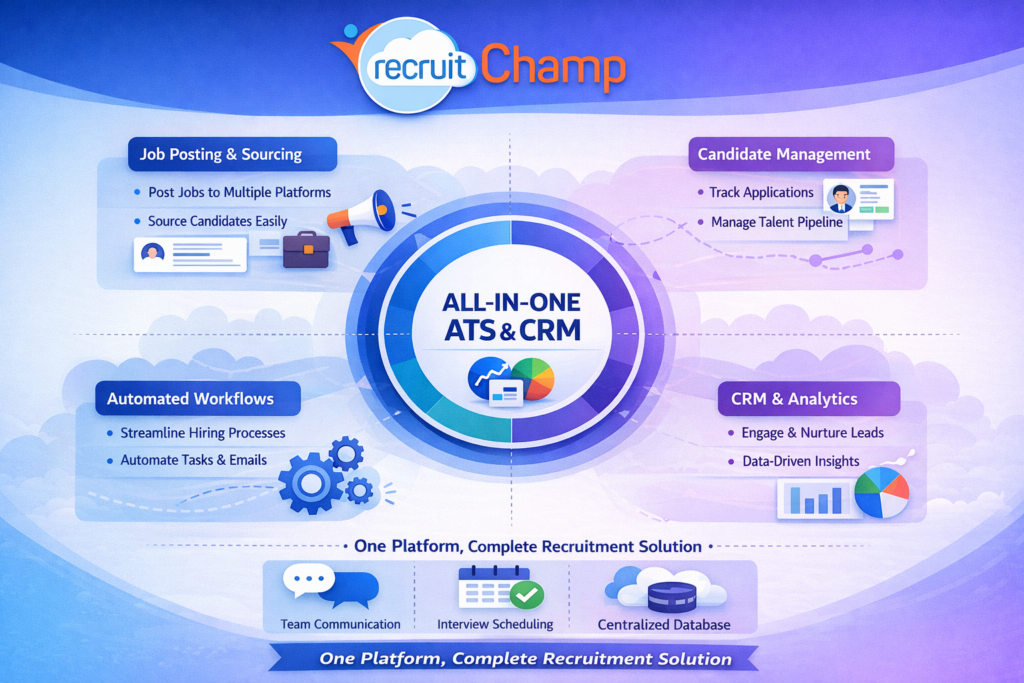
Many of the challenges in centralizing recruitment come from managing multiple tools, inconsistent data, and limited visibility across candidate interactions. recruitChamp addresses these challenges by combining ATS and CRM capabilities within a single recruitment management platform.
Managing candidate relationships and hiring workflows separately often leads to missed communication and incomplete data. recruitChamp solves this by combining ATS and CRM capabilities within a single recruitment management platform.
Instead of switching between tools, recruiters can manage applications, communication, engagement history, and hiring stages from one centralized system. Every candidate interaction, from first outreach to final offer, remains connected to a single profile.
recruitChamp enables teams to:
- Track candidate progress and engagement in one unified view
- Manage talent pools and nurture passive candidates effectively
- Automate follow ups and hiring workflows without losing personalization
- Improve collaboration between recruiters and hiring managers
- Maintain consistent communication across all candidate touchpoints
By bringing ATS and CRM integration into one platform, recruitChamp helps recruitment teams reduce manual work while improving candidate experience. Recruiters spend less time managing systems and more time building meaningful conversations with candidates.
This approach allows organizations to scale hiring without losing visibility or control over the recruitment journey.
The Future of Recruitment Management Platforms
Recruitment is moving toward systems that combine data, communication, and automation into a single experience. Organizations no longer want separate tools for tracking and engagement. They want platforms that support the entire hiring lifecycle.
A modern recruitment management platform acts as a central hub where candidate data, engagement insights, and hiring workflows come together. This allows companies to scale hiring without losing the personal touch that candidates value.
As competition for talent increases, organizations that centralize candidate touchpoints will have a clear advantage. They respond faster, build stronger relationships, and make better hiring decisions because every interaction contributes to a complete picture.
Conclusion
ATS and CRM integration brings structure and continuity to hiring by connecting every interaction within a unified recruitment system.
Platforms like recruitChamp make this transition easier by combining ATS and CRM capabilities into a single recruitment management platform, helping teams centralize candidate touchpoints while delivering a better hiring experience.
This way, recruiters gain visibility, candidates receive consistent communication, and hiring workflows become faster and more predictable.
In a market where candidate experience directly impacts hiring success, centralization is not just an operational improvement. It is a strategic shift toward smarter and more human recruitment.