Summarize with AI
Recruitment has always depended on finding the right candidates at the right time. For many years, recruiters relied on manual search methods such as job boards, resume databases, referrals, and cold outreach. While these methods still exist, the volume of candidates and the speed of hiring today make manual sourcing difficult to sustain.
Today, recruitment teams are expected to hire faster while maintaining quality. This shift has led to the rise of AI candidate sourcing and automated sourcing tools. Instead of spending hours searching for profiles, recruiters can now use intelligent systems that identify, match, and recommend candidates based on data.
This article explains how candidate discovery has evolved, how AI is changing sourcing workflows, and why automated sourcing tools are becoming essential for modern recruitment teams.
The Problem with Manual Candidate Search
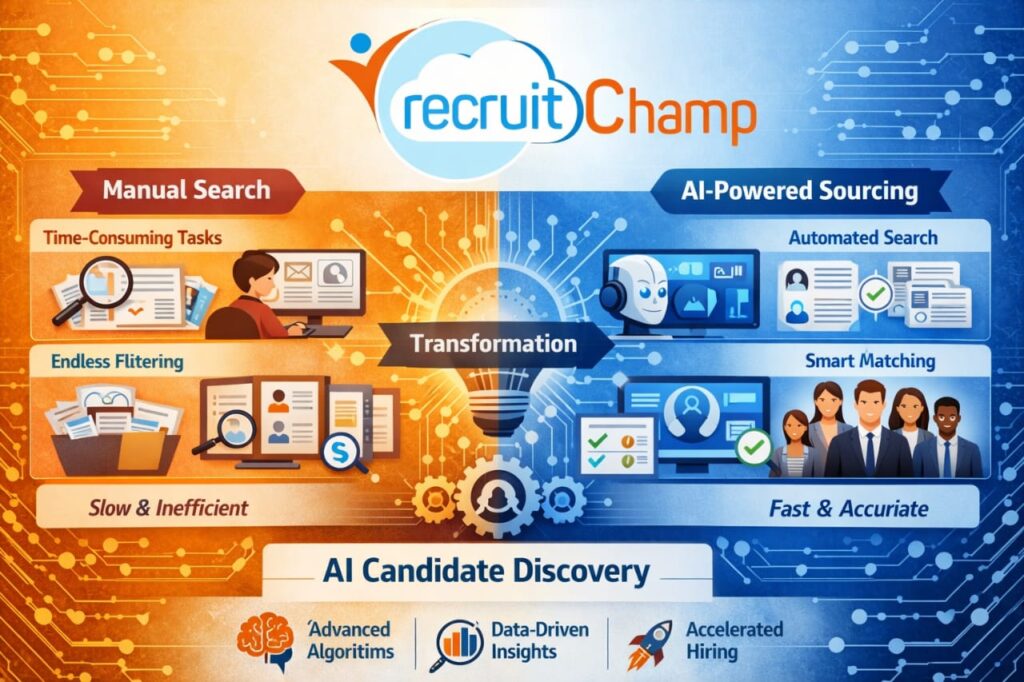
Recruiters often spend more time searching for candidates than engaging with them. This reduces productivity and slows down hiring cycles. As companies compete for talent, delays in discovery often result in losing strong candidates to faster competitors.
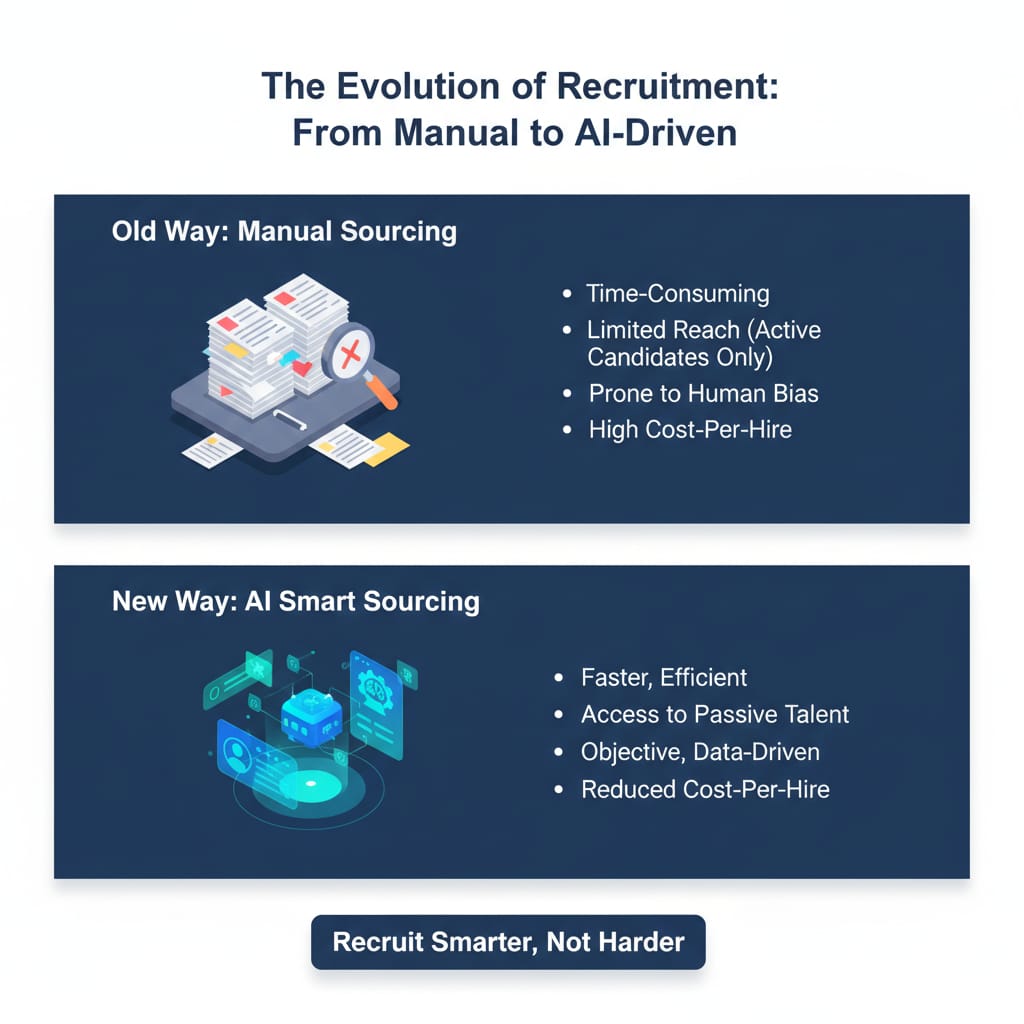
Manual sourcing worked when hiring volumes were lower and talent pools were smaller. Recruiters could spend time reviewing resumes, searching platforms, and reaching out individually to candidates. Today, that approach creates several challenges. Common issues with manual sourcing include:
- Time-consuming profile searches
- Inconsistent candidate matching
- Limited access to passive candidates
- Human bias during screening
- Delays in filling open positions
The Shift toward Smart Sourcing
Smart sourcing focuses on using data and automation to simplify candidate discovery. Instead of relying only on keywords or manual filtering, AI systems analyze multiple data points to identify suitable candidates.
AI candidate sourcing uses machine learning to understand job descriptions, skills, experience patterns, and hiring history. Over time, the system improves recommendations based on successful hires and recruiter feedback.
This shift allows recruiters to move from searching to selecting. Instead of building talent pools manually, automated sourcing tools present qualified candidates automatically.
The result is faster hiring and better alignment between job requirements and candidate profiles.
How AI Candidate Sourcing Works
AI candidate sourcing works by combining data analysis with automation. The system scans resumes, professional profiles, databases, and internal talent pools to identify potential matches. Here’s how AI candidate sourcing works:
Job Requirement Analysis
AI tools analyze job descriptions to understand required skills, experience level, and role expectations. The system goes beyond exact keyword matches and looks at related skills and transferable experience.
Candidate Matching
Automated sourcing tools compare job requirements with candidate data. Candidates are ranked based on relevance, reducing the need for manual screening.
Continuous Learning
As recruiters shortlist or reject candidates, the system learns from these actions. This improves future recommendations and increases accuracy over time.
Automated Discovery
AI tools continuously search for new profiles that match open roles. Recruiters receive updated candidate suggestions without running new searches.
This automation reduces repetitive tasks and allows recruiters to focus on communication and evaluation.
Benefits of AI in Candidate Discovery
AI candidate sourcing offers practical advantages for both recruiters and hiring managers. The goal is not to replace recruiters but to support faster and smarter decision-making. This way, various benefits can be reaped from AI in candidate discovery, including:
1. Faster Candidate Identification
Automated sourcing tools can analyze thousands of profiles within seconds. This significantly reduces the time spent on initial sourcing activities.
2. Access to Passive Talent
Many qualified candidates are not actively applying for jobs. AI tools help identify passive candidates who match role requirements based on skills and experience patterns.
3. Improved Candidate Matching
AI evaluates multiple data points instead of relying only on keywords. This leads to better matches and higher-quality shortlists.
4. Reduced Recruiter Workload
Automation handles repetitive tasks such as searching and filtering. Recruiters can spend more time engaging with candidates and improving candidate experience.
5. Data-Driven Hiring Decisions
AI sourcing provides insights into sourcing effectiveness, helping HR teams refine recruitment strategies over time.
Automated Sourcing Tools and Recruitment Efficiency
Automated sourcing tools play a major role in improving recruitment efficiency. They connect sourcing with other recruitment stages such as screening, communication, and pipeline management.
When sourcing becomes automated, hiring teams can respond faster to business needs. Open roles are filled more quickly, and recruitment teams can manage higher hiring volumes without increasing workload.
Key advantages of automated sourcing tools include faster pipeline creation, consistent evaluation criteria across candidates, and improved collaboration between recruiters and hiring managers.
Reducing Bias through AI-Powered Sourcing
One of the hidden challenges in manual recruitment is unconscious bias. Recruiters may unintentionally favor certain profiles based on familiarity or past experiences.
AI candidate sourcing helps reduce this issue by focusing on skills, experience, and role fit rather than personal preferences. Automated sourcing tools evaluate candidates using structured data, which improves fairness in early-stage screening.
While human judgment remains important, AI creates a more balanced starting point for candidate evaluation.
Challenges to Consider When Using AI for Sourcing
Despite its advantages, AI sourcing should be implemented carefully. Organizations must ensure that automation supports recruitment rather than replacing human decision-making.
Common challenges include:
- Poorly defined job descriptions leading to inaccurate matches
- Over-reliance on automation without recruiter review
- Data quality issues in candidate databases
- Resistance to adopting new technology
The most successful recruitment teams use AI as an assistant rather than a replacement. Human oversight ensures that hiring decisions remain aligned with company culture and long-term goals.
The Future of AI Candidate Sourcing
AI candidate sourcing will continue to evolve as recruitment technology improves. Future automated sourcing tools are expected to provide deeper insights into candidate potential, skill development, and career progression.
The future of recruitment technology will be shaped by the continued evolution of today’s emerging trends. Predictive sourcing driven by advanced analytics will help teams anticipate hiring needs and identify high-potential candidates before roles even open. Automated outreach personalization will enable recruiters to tailor communication at scale without sacrificing relevance. At the same time, real-time talent market insights will provide up-to-date data on skills availability, compensation benchmarks, and competitor hiring activity, allowing organizations to make faster and more informed decisions.
As competition for skilled professionals increases, companies that adopt smart sourcing methods will have a clear advantage.
Recruitment teams will move away from reactive hiring and focus more on building continuous talent pipelines supported by AI.
Conclusion
The transition from manual search to smart sourcing represents a major shift in modern recruitment. AI candidate sourcing and automated sourcing tools allow HR teams to discover talent faster, improve candidate matching, and reduce time spent on repetitive tasks.
Instead of manually searching through large databases, recruiters can rely on intelligent systems that continuously identify relevant candidates. This improves efficiency while allowing recruiters to focus on meaningful candidate engagement and hiring decisions.
As recruitment becomes more data-driven in 2026, organizations need sourcing solutions that combine automation with usability. Platforms like recruitchamp help recruitment teams move toward smarter sourcing by simplifying candidate discovery, organizing talent pipelines, and supporting faster hiring through AI-powered automation.