|
Getting your Trinity Audio player ready...
|
Hiring decisions involve numerous minor tasks. Surprisingly, recruiters often spend a significant amount of time on tasks that don’t directly contribute to decision-making.
Sourcing candidates across platforms and reviewing the resumes can be considered the most time-consuming for recruiters and hiring managers. They also would need to filter out unqualified profiles.
This is already hectic when done manually. It becomes more overwhelming when the hiring volume gets higher. Challenges and hurdles get multiplied and eventually slow down the entire recruitment process.
This is why AI sourcing and AI resume screening are becoming standard tools in modern recruitment. When used correctly, recruitment AI doesn’t replace recruiters; it becomes an efficient tool for tedious endeavors. It removes repetitive work so recruiters can focus on engagement, evaluation, and hiring decisions.
This article explains how recruiters use AI recruitment tools for sourcing and resume screening, where automation adds real value, and how it helps reduce time-to-hire without compromising quality.
The Real Challenge in Modern Recruitment
Recruitment today is no longer about filling a few open roles. Recruiters are expected to manage multiple job openings at once. Moreover, they are required to source candidates across multiple channels and screen large volumes of resumes instantly. Maintaining hiring quality under such tight deadlines and demands is not practical and realistic.
In high-growth companies and staffing agencies, this pressure is constant. Manual sourcing and resume screening simply don’t scale. Hence, the modern recruitment landscape has invited AI into its operations.
What AI Sourcing Means for Recruiters
AI sourcing refers to the use of artificial intelligence to identify, shortlist, and prioritize potential candidates from large talent pools.
The traditional sourcing methods depended on keyword search and manual filtering. Hours were spent on this, where each profile had to be sourced from some platform manually and reviewed for fit. The result may not always be beneficial.
Thus, the modern era has recruitment software that uses AI candidate sourcing tools to improve this sourcing process. AI analyzes data patterns rather than relying only on keywords. This way, AI sourcing tools can scan resumes and profiles at scale.
AI sourcing does not depend on human intervention to identify candidates. It does so by scanning profiles based on skills, experience, and relevance. AI algorithms consistently learn from past hiring decisions, enabling them to improve accuracy. So, instead of manually searching for candidates, you can leverage AI recruitment software from a reputed provider like RecruitChamp and make sourcing effortless.
How AI Recruitment Tools Improve Candidate Discovery
One of the biggest limitations of manual sourcing is visibility. Recruiters often miss strong candidates simply because they don’t use the exact keywords in their resumes.
AI recruitment tools go beyond keyword matching. These advanced tools understand skill relationships, recognize transferable experience, and identify similar candidate profiles based on past hires.
This allows recruiters to uncover candidates they might not have found through traditional sourcing methods. As a result, sourcing becomes more inclusive and efficient.
Why Resume Screening Slows Down Hiring
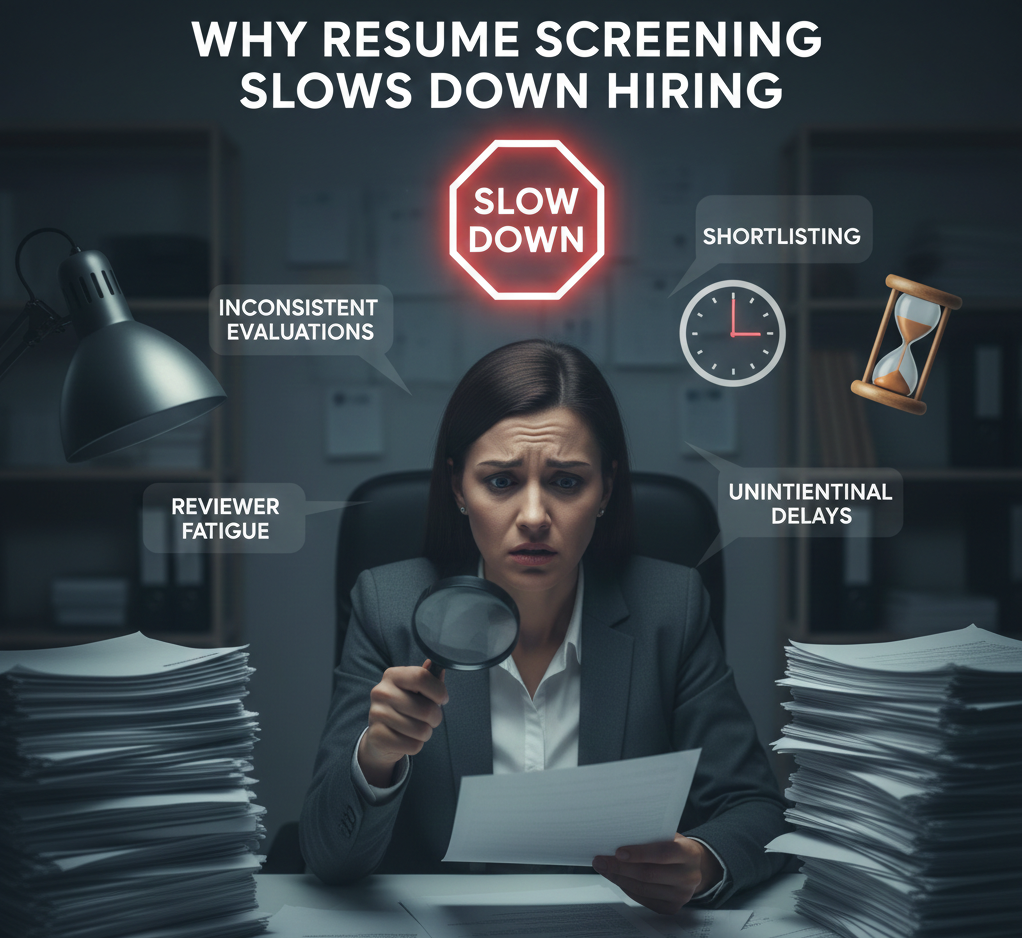
Resume screening is one of the most time-consuming stages in recruitment. Recruiters often review hundreds of resumes for a single role, especially in high-volume hiring scenarios.
- Manual screening creates several issues:
- Inconsistent evaluations
- Reviewer fatigue
- Unintentional bias
- Delays in shortlisting
How AI Resume Screening Works
AI resume screening uses machine learning models to analyze resumes and match them against job requirements.
Instead of scanning resumes line by line, AI systems extract key information automatically from sources. They also compare candidate profiles against job criteria, which means AI ensures that the profile matches the job description by identifying relevant skills, experience, and qualifications. By scanning all the resumes, AI systems rank the profiles based on the best fit for the organization.
With that, recruiters receive a shortlist rather than a pile of resumes. This doesn’t mean every decision is automated. Recruiters still review shortlisted candidates. AI simply reduces the volume of resumes they need to evaluate manually.
Reducing Bias through Consistent Screening
Human screening decisions can vary based on mood, workload, or unconscious bias. AI resume screening applies the same criteria consistently across all candidates.
When configured correctly, AI helps to standardize screening criteria, reduce subjective filtering, and ensure fairer comparisons. Thus, ensuring recruiters maintain oversight while benefiting from consistency.
AI Sourcing and Screening in High-Volume Recruitment
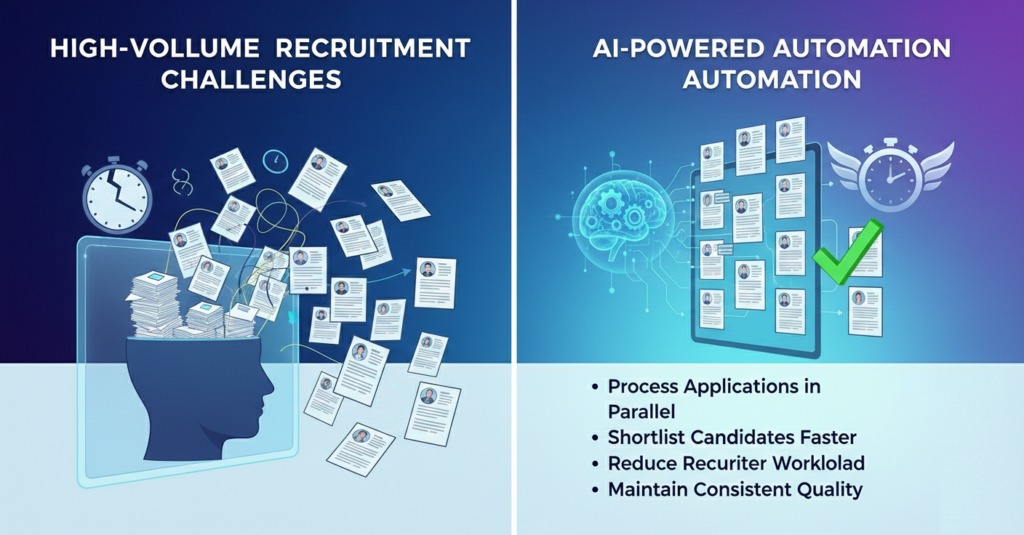
Without automation, high-volume recruitment becomes unsustainable. Thus, high-volume hiring is where AI delivers the biggest impact.
In industries such as staffing, retail, healthcare, and customer support, recruiters handle thousands of applications. Manual processes slow everything down.
High-volume recruitment automation using AI allows teams to:
- Process applications in parallel
- Shortlist candidates faster
- Reduce recruiter workload
- Maintain consistent quality
How Automation Reduces Time-to-Hire
Time-to-hire is a critical metric for recruitment teams. Delays often occur at the sourcing and screening stages. AI recruitment solutions allow recruiters to move qualified candidates into interviews faster.
Faster hiring improves candidate experience and reduces the risk of losing top talent.
With that, here’s how recruitment AI actually reduces time-to-hire:
- It automates candidate discovery
- Eliminates manual resume filtering
- Prioritizes best-fit candidates early
- Reduces back-and-forth during screening
The Recruiter’s Role in an AI-Driven Workflow
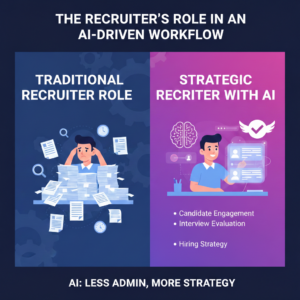
A common misconception is that AI replaces recruiters. In reality, AI reshapes the recruiter’s role and makes recruitment more strategic & less administrative.
With AI handling sourcing and screening, recruiters focus on:
- Candidate engagement
- Interview evaluation
- Stakeholder communication
- Hiring strategy
Using AI Recruitment Tools Responsibly
AI sourcing and AI resume screening work best when used with human oversight. Just because AI is highly intelligent doesn’t mean you completely handover the process to a machine. AI is a support system, not a decision-maker.
Keeping that in mind, recruiters must ensure to review AI-generated shortlists, adjust criteria and rules as roles evolve, monitor outcomes, and ensure the accuracy of the AI models for transparent decision-making.
Can AI be integrated with Existing Recruitment Systems?
Recruiters don’t need to switch between tools or manage disconnected systems. AI recruitment tools are most effective when integrated into ATS platforms.
This allows:
- Seamless data flow
- Centralized candidate tracking
- Better reporting and analytics
Challenges Recruiters Should Be Aware Of
While AI offers clear benefits, adoption comes with considerations. The mentioned challenges are manageable with proper configuration and ongoing review.
The Potential challenges include:
- Poor data quality affecting results
- Over-reliance on automation
- Lack of recruiter training
- Misaligned screening criteria
Best Practices for Implementing AI Sourcing and Screening
Following certain practices will ensure long-term value rather than short-term gains. Best practices include:
- Start with sourcing and screening use cases
- Train AI models on relevant data
- Involve recruiters in configuration
- Monitor performance regularly
- Treat AI as an evolving system
The Future of Recruitment AI
AI sourcing and resume screening are only the beginning. As recruitment AI evolves, tools will become more predictive and context-aware.
Future systems will anticipate hiring needs, recommend talent pipelines proactively, and will learn to improve candidate matching constantly. The future is now. To stay ahead in the competitive hiring market, it’s time to move away from traditional methods and stop relying on manual sourcing and screening.
It all begins today. Partner with recruitChamp for a robust AI recruitment system that delivers advanced automation. Recruiters who embrace AI today will shape the future of this landscape.
Conclusion
Sourcing and resume are indeed time-intensive tasks of recruitment, as explained clearly in this article. Manual processes can no longer keep up with the volume and the demands of modern hiring. It complicates the scaling process as well for recruitment agencies.
AI is the answer to missed out efficiency. Adopting AI recruitment tools that allow automation of resume screening and sourcing will reduce administrative workload once and for all.
AI sourcing and AI resume screening are not just about improving hiring speed; it’s about focusing on what matters most: hiring the right candidates.
AI recruitment is not about replacing existing recruiters; it’s about giving them the support they need to focus on complex cases.