All-in-One ATS Recruitment has always been a people business. But behind every great hire is a process, and increasingly, that process is either working for your team or quietly working against it.

For years, recruiters have patched together a collection of tools: a job board here, a spreadsheet there, a CRM bolted on the side, a WhatsApp thread in between. It gets the job done, until it doesn’t. Until a candidate falls through the cracks. Then a client chases you for an update you can’t quickly find. Until your best recruiter spends half their Friday reconciling timesheets instead of closing roles.
This is precisely why the shift toward an All-in-One ATS is not just a technology trend. It is a fundamental rethinking of how modern recruiting teams operate, scale, and compete.
The Real Cost of Disconnected Tools
Most recruitment firms don’t fail because they lack talent. They struggle because their tools don’t talk to each other.
Think about the average recruiter’s day. They might source a candidate on LinkedIn, log a note in one system, schedule an interview through another, share a shortlist over email, update a timesheet in a spreadsheet, and invoice through something else entirely. Each step involves a different tool, a different login, and a different risk of something getting lost.
This kind of fragmentation is more than an inconvenience. It is a structural drag on performance. Data silos mean recruiters duplicate effort. Missed follow-ups mean candidates disengage. Incomplete records mean managers can’t make informed decisions. And when you’re running high-volume hiring across multiple clients and roles simultaneously, the compounding effect of these small inefficiencies becomes significant.
What’s striking is that many agencies accept this friction as normal. It isn’t. It’s a solvable problem, and a growing number of forward-thinking firms are solving it by consolidating onto an All-in-One ATS platform that brings the entire recruitment lifecycle under one roof.
Why the Market Is Moving Fast
The numbers tell a clear story. The global ATS market is valued at approximately USD 7.43 billion in 2025 and is projected to nearly double by 2035. That’s not incremental growth. That’s an industry in transformation.
The reason is straightforward: hiring has become more complex, more distributed, and more competitive all at once. Remote work has expanded candidate pools globally. Clients expect faster turnaround and richer data. Candidates expect a seamless, responsive experience or they disengage. Regulatory requirements around compliance and data handling are tightening. And recruiters themselves are under pressure to do more with leaner teams.
Point solutions, however well-designed, were built for a simpler era. An All-in-One ATS is built for this one.
Speed and Efficiency that Actually Show Up in Results
One of the most consistently cited benefits of a modern ATS is its impact on time-to-hire. Research shows that more than 86% of recruiters say their Applicant Tracking System has reduced the time it takes to fill a role, with some environments reporting hiring cycle reductions of up to 60% once processes are automated and centralized.
That figure deserves some reflection. A 60% reduction in time-to-hire doesn’t just mean faster placements. It means happier clients, more roles filled per quarter, and a stronger competitive position in the market. For staffing agencies working on thin margins and high volumes, that kind of efficiency translates directly to revenue.
An All-in-One ATS achieves this by automating the repetitive, time-consuming work that tends to fill a recruiter’s day: resume parsing, interview scheduling, approval workflows, vendor coordination, and candidate communications. When these tasks happen automatically and within a single system, recruiters reclaim hours every week, hours they can redirect toward building relationships, developing client accounts, and closing roles.
Quality of Hire: The Metric That Matters Most
Efficiency is one side of the equation. Quality is the other, and here too, the evidence for an integrated ATS is compelling.
Nearly 79% of recruiters report that quality of hire improves after implementing an ATS, with 62% saying they consistently surface higher-caliber candidates compared to teams using fragmented or manual processes. These aren’t marginal improvements. They reflect what happens when structured data, consistent evaluation criteria, and AI-assisted matching replace gut instinct and inbox archaeology.
When every candidate interaction, every client requirement, every submission history, and every placement outcome lives in one connected system, recruiters develop a richer and more accurate picture of what good looks like, for each role, each client, and each market. Over time, that institutional knowledge compounds. Hiring decisions become more consistent, more defensible, and more aligned with what clients actually need.
This matters especially for specialist recruiting firms in IT, healthcare, BFSI, and Salesforce talent, where the difference between a good hire and a great one can have a material impact on a client’s business. In those environments, precision isn’t a luxury. It’s the service.
The Candidate and Client Experience Gap
Here is something worth considering: in a competitive talent market, the experience a recruiter provides is itself part of the offering.
Candidates today expect timely communication, mobile-friendly interactions, and clear visibility into where they stand in a process. When that experience is slow or inconsistent, often because recruiters are managing too many tools manually, candidates disengage. They accept the other offer. They tell their network. On the client side, the expectations are elevated. Clients want real-time visibility into shortlists and submissions. They want confidence that their preferred supplier has the process and the data to deliver consistently. An agency running on spreadsheets and disconnected tools will struggle to inspire that confidence, however strong their relationships.
Research reflects this: 94% of recruiters say their ATS has a positive impact on hiring processes. An All-in-One ATS enables firms to deliver a professional, responsive experience to both candidates and clients, at scale.
Built for Complexity: Multi-Line Staffing Operations
Many staffing agencies don’t run a single line of business. They manage permanent placements, contract staffing, MSP and VMS programs, timesheets, invoicing, and client P&L, all at once, often across multiple locations and geographies. Managing that complexity across four or five separate tools isn’t just inefficient. It’s risky. Data gets lost between systems. Finance and delivery teams work from different versions of the truth. Margins are hard to track in real time.
A genuinely integrated All-in-One ATS, one that connects applicant tracking, CRM, vendor management, and basic finance functions, doesn’t just streamline recruiting. It gives leadership the visibility to run the business more confidently: tracking gross margin by client, monitoring recruiter productivity, managing job board credits, and staying on top of compliance, all from a single platform.
This is where the real strategic value of an integrated approach becomes apparent. It’s not just about filling roles faster. It’s about building a scalable, data-driven operation that grows without proportionally growing its administrative overhead.
Why Salesforce-Native Matters
For agencies already operating on Salesforce, or those looking to standardize on it, the case for a Salesforce-native All-in-One ATS is particularly strong. Rather than integrating an external ATS via API and hoping the data sync holds, a native solution means that candidates, clients, jobs, contracts, and financial data all live within the same data model.
This architectural decision has compounding benefits. Every automation, every report, every AI feature, and every customization draws on the same shared data. Teams across recruitment, account management, and back-office operations work from a single source of truth, and that alignment, more than any individual feature, is what enables agencies to scale with confidence.
recruitChamp: Built for the Way Recruiting Actually Works
This is the gap that recruitChamp was designed to close.
Built natively on Salesforce and purpose-built for staffing and recruitment agencies, recruitChamp brings together ATS, CRM, vendor management, timesheet management, and invoicing in one connected platform. It’s designed for multi-recruiter, multi-client, multi-line-of-business reality of modern staffing, not as a generic HR tool adapted for recruiting, but as a recruiter-first system built from the ground up for the way this industry actually operates.
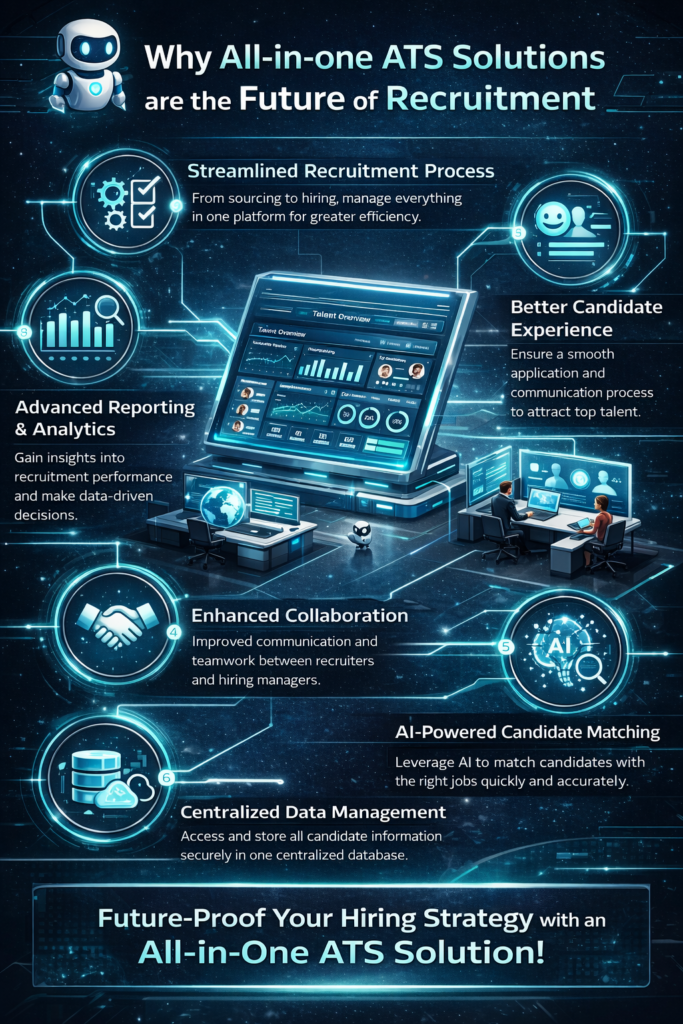
For firms running high-volume hiring across permanent, contract, and MSP programmes, recruitChamp eliminates the tool-hopping and data fragmentation that slow teams down. Recruiters get automated workflows, AI-powered candidate matching, and seamless communication tools, all within Salesforce. Finance and ops teams get real-time visibility into margins, billing, and compliance. Leadership gets the data to make strategic decisions, not just operational ones.
And for firms that want to see the difference before committing, recruitChamp offers a 14-day pilot designed to demonstrate ROI quickly, with fast time-to-value and the flexibility to adapt to each firm’s specific workflow.
The Direction of Travel Is Clear
Recruitment is not getting simpler. Talent markets are tightening. Client expectations are rising. The volume and complexity of hiring operations continue to grow. In that environment, the agencies and recruiting teams that will thrive are the ones that invest in platforms built for the long game, not collections of tools that solve today’s problem while creating tomorrow’s headache.
An All-in-One ATS is no longer a forward-looking aspiration. For the most competitive firms in the market, it is already the standard. The question is simply whether your operation is moving in that direction, or being left behind by those who already are.
Frequently Asked Questions
- What is the cost of using fragmented tools?
Disconnected systems create data silos and “structural drag,” leading to lost candidates, duplicated effort, and a lack of real-time visibility. - How does it improve efficiency? By automating tasks like resume parsing and scheduling, an ATS can reduce time-to-hire by up to 60%, allowing recruiters to focus on building relationships
- Does it improve candidate quality?
Yes; 79% of recruiters report better hire quality as integrated data and AI matching replace gut instinct with consistent evaluation criteria. - Why choose a Salesforce-native solution like recruitChamp?
It ensures all data lives in one model without sync delays, providing a single source of truth across recruitment, finance, and operations. - How does it handle operational complexity?
It streamlines multi-line businesses (perm, contract, MSP) by connecting tracking, CRM, and invoicing to manage margins and compliance from one platform.