In the staffing and recruitment industry, the gap between placing a candidate and receiving payment can often stretch into months. This delay creates significant cash flow pressure and limits a firm’s ability to reinvest in growth.
While many agencies focus on the front-end sales process, the back-office billing cycle is where revenue is actually secured. A staffing invoicing system integrated with smart technology is now the primary solution for firms seeking to optimize this process and ensure financial stability.
By moving away from manual tracking and adopting specialized recruitment billing software, businesses can eliminate the administrative errors that lead to payment disputes. This transition ensures that invoices are not just sent faster, but are more accurate and easier for clients to process.
To understand how to fix these delays, we must first look at why traditional methods fail.
Why do traditional billing methods cause frequent payment delays?
The primary reason for slow payments in recruitment is not always a client’s lack of funds. It is often the friction caused by outdated manual processes. When invoices are handled through spreadsheets or generic accounting software, the risk of error increases significantly.
If a client receives an invoice with incorrect hours or a missing purchase order number, the payment process stops while the error is investigated.
Are manual errors the biggest threat to your agency cash flow?
In the high-volume world of staffing, a single recruiter might manage dozens of placements with different fee structures and tax requirements.
Without a dedicated system, tracking these variables manually is nearly impossible. Miscalculations in commission or hours worked lead to client frustration and lengthy reconciliation periods.
A smart system catches these discrepancies before the invoice is ever generated, ensuring the first document sent is the correct one.
How does fragmented data lead to missing invoices?
In many agencies, recruitment data sits in one system while billing data sits in another. This lack of communication between departments means that placements can go unbilled for weeks simply because the finance team was not notified of a successful hire.
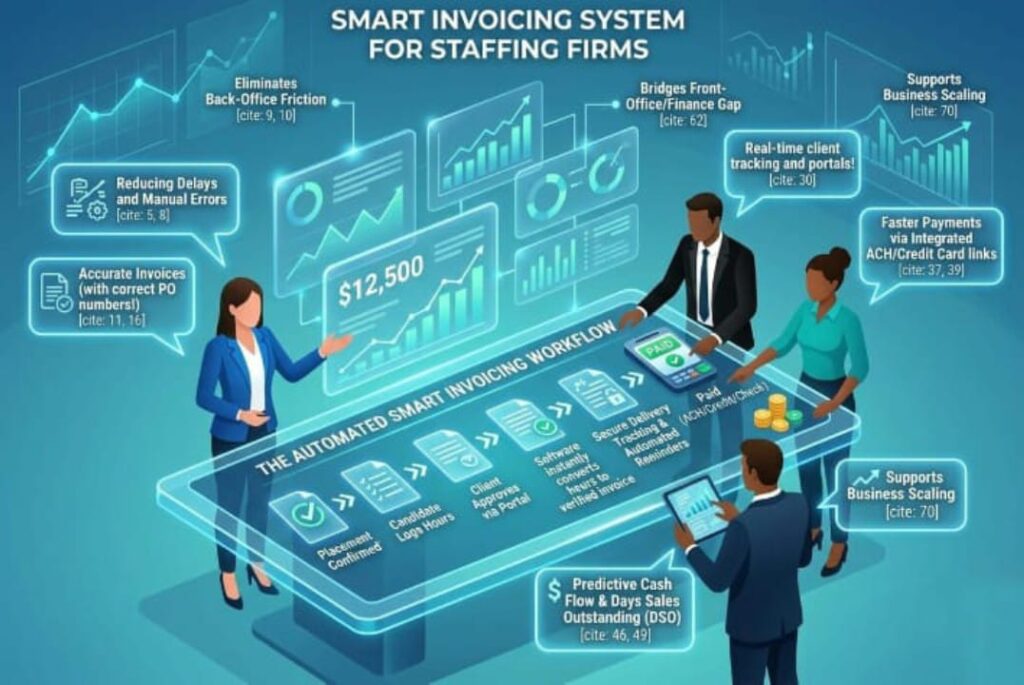
Smart software bridges this gap by automatically pulling placement data into the billing cycle the moment a contract is signed. This synchronization ensures that every hour worked is accounted for and billed promptly.
Identifying these structural flaws is only the beginning. Once an agency understands the source of the delay, it can implement technology to accelerate the entire cycle.
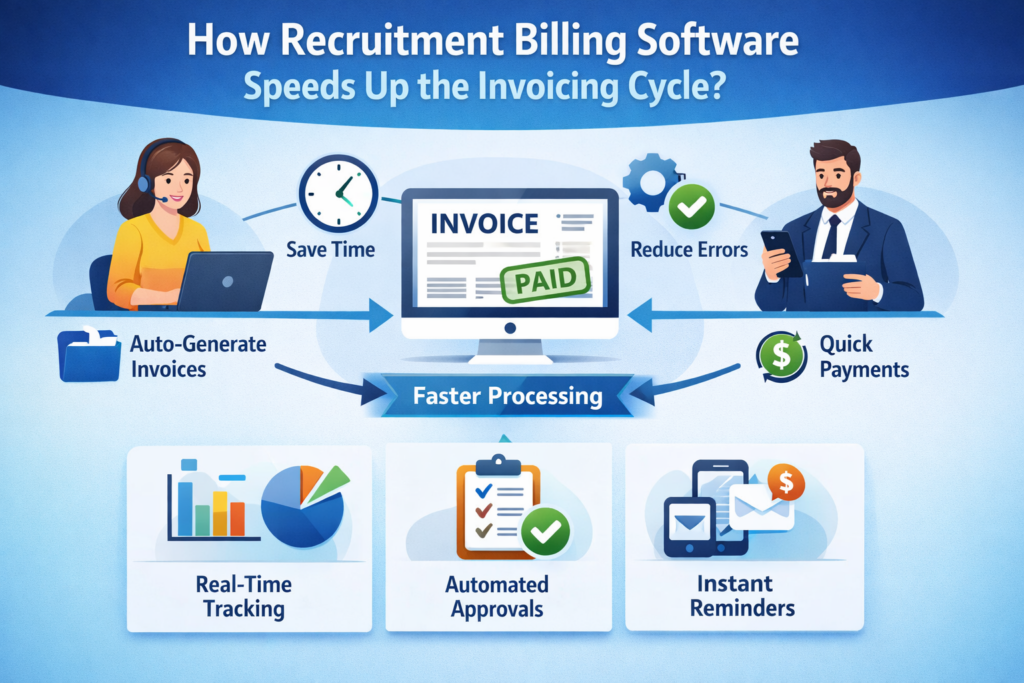
How does Recruitment Billing Software Speed Up the Invoicing Cycle?
The most effective way to reduce the time between a placement and a payment is to automate the generation and delivery of invoices. A modern staffing invoicing system removes the human labor required to compile billing data, allowing invoices to go out in minutes rather than days.
Can automated time-tracking reduce the wait for client approval?
For contract staffing, the biggest delay often occurs during the timesheet approval process. If a recruiter has to chase a client for a signature every Friday, the entire billing cycle is held hostage.
Smart invoicing systems offer digital portals where candidates log hours and clients approve them with a single click. Once approved, the software instantly converts these hours into a verified invoice, cutting out days of back-and-forth communication.
Why is real-time delivery better than traditional email attachments?
Invoices sent as simple email attachments can easily be buried in a client’s inbox or flagged by spam filters. Advanced software uses secure delivery tracking and client portals.
This allows the agency to see exactly when an invoice was opened. If an invoice remains unviewed, the system can trigger an automatic reminder. This keeps the bill at the top of the client’s priority list without requiring a manual follow-up from your team.
While speeding up the delivery is vital, the next step is making it as easy as possible for the client to complete the transaction.
What Features of a Smart Invoicing System Encourage Faster Payments?
A client is much more likely to pay an invoice quickly if the process is convenient. Smart systems focus on the user experience of the person paying the bill, providing them with all the tools they need to complete the transaction immediately.
Do integrated payment links actually improve collection times?
When an invoice includes a payment button that leads to a secure portal with multiple options, such as ACH or credit card, the barrier to payment is removed.
Clients do not have to log into their separate banking systems or print and mail checks. Providing these options directly within the digital invoice can reduce the payment cycle by as much as 30 percent.
How does detailed reporting prevent client disputes?
Transparency is a major factor in payment speed. Clients often delay payments if they cannot verify the charges on an invoice. A smart system attaches supporting documentation, such as approved timesheets and placement contracts, directly to the invoice file. When the client has all the evidence they need in one place, they are less likely to put the invoice on hold to ask for clarification.
Facilitating individual payments is helpful, but the ultimate goal is to use this technology to manage the overall financial health of the business.
How can Agencies Use Billing Data to Predict and Manage Cash Flow?
One of the greatest advantages of using a professional recruitment billing software is the access to deep financial analytics. Instead of wondering when money will arrive, managers can use historical data to forecast their cash position with high accuracy.
Can the system identify slow-paying clients before they become a problem?
Not all clients have the same payment habits. A smart system tracks the Days Sales Outstanding for every client in your portfolio. If the data shows that a specific company consistently pays late, the agency can adjust its strategy.
This might involve setting shorter payment terms or requiring a deposit upfront. Having this data allows the agency to manage risk proactively.
What is the value of automated aging reports for the finance team?
In a manual system, generating an aging report can take hours of work. With an automated system, these reports are available in real-time. The finance team can see at a glance which invoices are nearing their due date and which are overdue.
This allows for more targeted collections efforts, focusing on the largest or most overdue accounts first to maximize the impact on the bank balance.
This transition from reactive to proactive financial management is best achieved through a comprehensive platform like recruitChamp.
How recruitChamp Bridges the Gap between Hiring and Payment?

For agencies looking for a unified solution, recruitChamp provides a platform that connects the hiring process directly to the financial outcomes. It acts as more than just a tool for recruiters. It serves as a central hub that ensures no placement goes unbilled.
Does recruitChamp integrate recruitment and finance data?
The recruitChamp solution eliminates the gap between the front office and the back office. By linking candidate placements directly to the staffing invoicing system, it ensures that billing is triggered automatically.
This level of integration removes the need for manual data transfer and significantly reduces the chance of human error. As soon as a placement is confirmed, the financial framework is already in place to capture revenue.
How does recruitChamp improve the client and candidate experience?
The platform offers a professional interface for candidates to log their time and for clients to approve it. This transparency builds trust and makes the entire relationship more professional. By providing a clear and easy-to-use portal, recruitChamp helps agencies look more established and reliable. This professional image is essential when an agency begins to scale its operations.
How does a Staffing Invoicing System Support Business Scaling?
As an agency grows, the volume of invoices increases exponentially. A process that worked for ten placements will fail when the agency reaches a hundred. Scaling requires a system that handles the increased workload without requiring more administrative staff.
Key features that help scale your agency’s billing process:
- Multi-Entity Billing: Manages different branches or brands within one software suite.
- Currency Automation: Handles international placements with automatic exchange rate updates.
- Tax Compliance: Automatically applies the correct taxes based on the hire location.
- Bulk Processing: Sends hundreds of verified invoices with a single command.
Can AI assist in resolving complex billing disputes?
Smart systems can flag anomalies, such as a candidate logging significantly more hours than their contract allows.
By alerting the recruiter before the invoice is sent, the agency can verify the hours with the client and candidate ahead of time. This prevents the dispute from ever happening, keeping the relationship healthy and the payments on schedule.
Is the software capable of growing with your placement volume?
A cloud-based system ensures that as your placement volume grows, the software performance remains consistent. There is no need for local server upgrades. This reliability is vital during periods of rapid growth, as it ensures that the billing department never becomes the reason the company cannot take on new clients.
Conclusion
Reducing payment delays is not about being more aggressive with collections. It is about building a more intelligent and efficient billing process. A dedicated staffing invoicing system removes the human errors and technical friction that cause clients to hold onto their money longer than necessary.
By investing in recruitment billing software, agencies gain the transparency, speed, and accuracy needed to maintain a healthy cash flow. This technology provides a foundation for financial stability and long-term growth.
When the billing cycle is automated and data-driven, the agency can spend less time chasing checks and more time finding the talent that drives their business forward.